
Sound before self-consciousness
Listening and pronunciation are not left until later. Learners hear how the language moves from the first lesson, which helps them recognize patterns sooner and speak with less hesitation.
Linguinate is a language platform for serious learners. Instead of disconnected drills, every lesson begins inside a vivid scene and then guides the learner through listening, vocabulary, pronunciation, grammar, and consolidation in one connected arc.
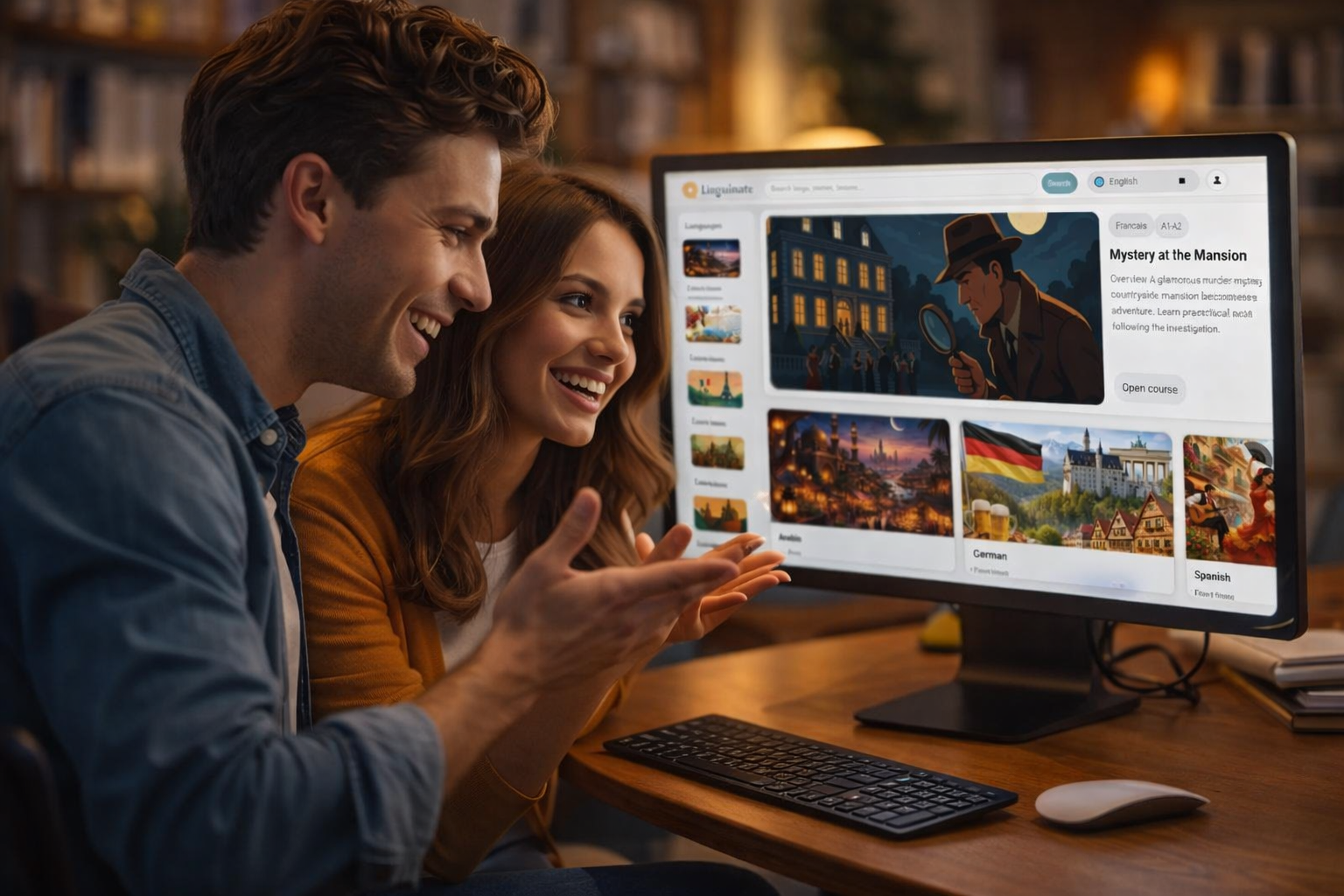
With Linguinate language becomes something you can hear, follow, say, and remember.
Linguinate is built around a simple idea: language is a living system of sound, meaning, and context. Linguinate focuses on building listening, reading, understanding and communication skills. It is about helping learners build real operational ability through connected material that respects their intelligence.
Listening and pronunciation are not left until later. Learners hear how the language moves from the first lesson, which helps them recognize patterns sooner and speak with less hesitation.
Vocabulary, grammar, and culture arrive inside meaningful situations. That gives the learner something to picture, remember, and return to instead of a stack of disconnected examples.
The goal is not casual dabbling. It is guided progression from A1 to C2, with content that grows from practical situations toward abstract, professional, and intercultural fluency.
The learning loop stays connected. Instead of splitting listening, vocabulary, pronunciation, and grammar into separate silos, Linguinate keeps them inside one memorable scene and asks the learner to work with that material in the right order.
The process below comes straight from the platform philosophy: engage with the scene, listen properly, review the key vocabulary, practice pronunciation, and consolidate before moving on.
Start with the place, the people, and the purpose. Gist comes first. Mastery comes later.
Use the audio to absorb rhythm, repeated phrases, and the natural sound of the language in motion.
Important words and structures are easier to retain when they are tied to a concrete interaction.
Repetition is not cosmetic here. It sharpens the ear, strengthens memory, and lowers hesitation.
Re-listen, review, retell, roleplay, and revisit. That is where understanding turns into durable ability.

Language is not a list of words or rules. It is a living system of sound, meaning, and context.
Learning language is not about learning vocabulary lists or arcane grammar, it is about opening up and exploring the world through travel, humor, ritual, attraction, friendship, and atmosphere. Those are the kinds of moments that make vocabulary memorable because the language belongs to a scene that feels human. Linguinate's courses are designed to

Directions, introductions, impressions, and small talk all become easier to remember when the learner can picture the street and the people on it.

Storytelling, agreement, humor, and social warmth are richer learning material than sterile drills because they carry emotion and rhythm.

Language is inseparable from ritual, etiquette, and place. Culture should deepen as the learner moves upward through the levels.

Planning, descriptions, reactions, and spontaneous speech all become more vivid when there is a concrete memory attached to them.

Relationships, tone, and what people really mean matter because real language is about connection not dictionary definitions.
Food, movement, choices, pressure, and noise create exactly the sort of context that helps learners retain phrases and decode speech.
Courses are built around CEFR modules so the language is appropriate to your level. This increases comprehension, learning and helps you progress quickly. Beginner lessons stay concrete and scene-linked. Intermediate levels add narrative control and everyday problem-solving. Advanced stages move into argument, professional language, media analysis, and cultural nuance.
Build survival comprehension, pronunciation habits, everyday vocabulary, and confidence in short, realistic interactions.
Narrate events, solve predictable problems, and manage longer scenes with more natural pacing and recall.
Handle abstract topics, workplace situations, debate, and multi-person dialogue without losing the thread.
Operate with persuasion, register control, cultural depth, and the ability to follow complex professional material.
Linguinate is designed for mastery. Nothing is more motivating than mastering a new skill and having interesting material to engage with. Language learning becomes part of your intellectual life. That means thoughtful sequencing, diagnostic starting points, hands-free listening, and cultural material that grows from practical to societal to professional.
Meet learners where they are instead of forcing everyone through the same opening loop.
Reinforcement during walks, chores, or commutes multiplies the value of focused study time.
Practical notes at the start can deepen into history, norms, institutions, and worldview later on.
The destination is real listening, real speaking, and real confidence in situations that actually matter.
If the direction feels right, send a quick note with the language you care about and what kind of learning experience you want. This static site will open a prefilled email so the first version can start collecting genuine interest without extra infrastructure.
Share a few details and Linguinate will have the context needed for follow-up conversations, launch updates, and the first cohort of testers.
Linguinate is designed for learners who want more than recognition drills and more than vague immersion. Scenes create memory. Audio creates familiarity. Structure creates momentum. Put together, they create language you can actually use.